Client Record Book: A Powerful Asset for Your KDP Interiors Business
If you're building a low or no-content business on Amazon's Kindle Direct Publishing platform, you've likely discovered the vast potential of interior templates. These pre-designed pages allow creators to offer valuable tools—like planners, journals, and logbooks—without the need for complex graphic design skills. Among these, a well-structured Client Record Book stands out as a particularly practical product. It serves professionals across numerous fields, from freelancers and consultants to small business owners and coaches, providing a unified space to manage client details, sessions, payments, and notes.
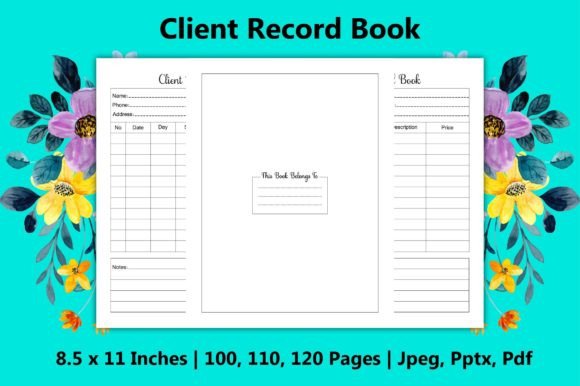
The instant download package for the Client Record Book - KDP Interiors promises a streamlined path to publishing. It includes ready-to-upload files in multiple formats (JPEG, PDF, PPTX) for page counts of 100, 110, and 120, all set to the standard 8.5" x 11" dimensions with no bleed and a black and white interior. However, the simplicity of the offer can sometimes lead to overlooked details that impact the final product's quality and your business success. Let's explore some common missteps and how to navigate them effectively.
Overlooking the Importance of Format Compatibility
A frequent assumption is that any uploaded file will work seamlessly with Amazon KDP's system. The package provides JPEG pages, a consolidated PDF, and PPTX files, which is excellent for flexibility. Yet, the mistake lies in not verifying the specific requirements of your chosen publishing path. For instance, if you intend to use the PDF file for a seamless upload, you must confirm its resolution and formatting align with KDP's specifications for black and white interiors. A file tested correctly on one device might display pixelation or margin errors on another.
The better approach is to treat the provided files as a starting point. Before final upload, use Amazon's own previewer tool to inspect the PDF. Check for any unintended gray tones or shading that could print poorly, ensuring true black and white clarity. If you opt for the individual JPEG pages, confirm they are all uniformly sized. This diligence prevents costly revisions after submission and ensures your customers receive a crisp, professional-looking book.
Misjudging Page Count Selection for Market Needs
Having options of 100, 110, and 120 pages is advantageous, but selecting a count arbitrarily can hinder your product's appeal. Beginners often choose the highest page count thinking it offers more value, but this isn't always true. A 120-page client record book might feel overwhelming for a solopreneur with a handful of clients, while a 100-page version could be insufficient for a busy therapist or agency.
Consider your target audience realistically. A life coach or freelance designer might prefer a compact, 100-page book for a clean, manageable record system. A legal consultant or accounting firm dealing with extensive case notes may need the 120-page version. Research similar successful listings on KDP to see what page counts are popular in your niche. The practical advice is to match the utility to the user's actual workflow, not just the number of pages.
Neglecting the "No Bleed" Setting in Design Context
The specification no bleed is clearly stated, yet its practical implication is sometimes misunderstood. Bleed refers to printing where the design extends beyond the trim edge. A "no bleed" setup is perfect for this type of functional interior, as it focuses on clean margins and text. However, a mistake occurs if a creator later tries to add decorative border elements or full-page graphics that inadvertently touch the edge, expecting them to print correctly.
Remember, with a no bleed setting, all critical content must stay well within the safe margin area. Use the provided files as a guide for layout. If you customize the PPTX files to add your logo or adjust headings, keep elements centered and away from the outer inch of the page. This ensures no content is accidentally trimmed during Amazon's printing process, maintaining a polished final product.
Underestimating the Value of a Structured Interior
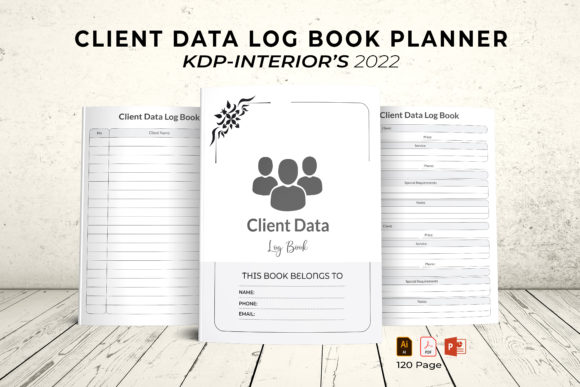
The Client Record Book - KDP Interiors isn't just a collection of blank pages; it's a pre-organized template. A common oversight is viewing it merely as a generic notebook, missing the opportunity to highlight its specific structure in your product description. The interior likely includes sections for client contact information, meeting logs, payment tracking, and notes—a purposeful layout that saves professionals time.
To avoid this, thoroughly review all sample pages in the download. Craft your Amazon listing title and description to speak directly to the pain points it solves. For example, instead of just "Client Record Book," describe it as "Organized Client Management Log with Session Tracking and Payment Sheets." This leverages the template's inherent design, making your product more attractive and useful to potential buyers searching for a solution, not just a blank book.
Furthermore, consider how this structure aids the user. A freelancer can quickly reference a client's project history; a therapist can maintain sequential session notes. By emphasizing these applications, you communicate practical value, which drives satisfaction and positive reviews.
Failing to Conduct a Final Usability Check
Even with tested files, the last step before publishing is a personal quality audit. This involves simulating the customer's experience. A mistake is relying solely on the provider's assurance that files are "KDP tested." Download the entire package and open the PDF in a common reader like Adobe Acrobat or Preview. Scroll through every page. Are all page numbers sequential? Are any headers or section titles inconsistently formatted?
Better yet, print a few sample pages at home on standard letter paper. Check the readability of fonts, the alignment of tables, and the clarity of any example text. Does the black and white print look sharp, not muddy? This hands-on test reveals issues software previews might miss. It also gives you confidence in the product you're about to sell, aligning with Google's E-E-A-T principles by demonstrating your firsthand experience and commitment to a helpful, trustworthy offering.
By approaching the Client Record Book - KDP Interiors download with this mindful, detail-oriented perspective, you transform a ready-made template into a robust, market-ready product. You avoid the pitfalls that lead to customer complaints or listing revisions and instead build a credible asset for your KDP business. Focus on compatibility, appropriate page count, design boundaries, structural benefits, and final verification. This process ensures the tool you provide truly helps your clients manage their workflows efficiently, making your low-content business a source of high-value solutions.